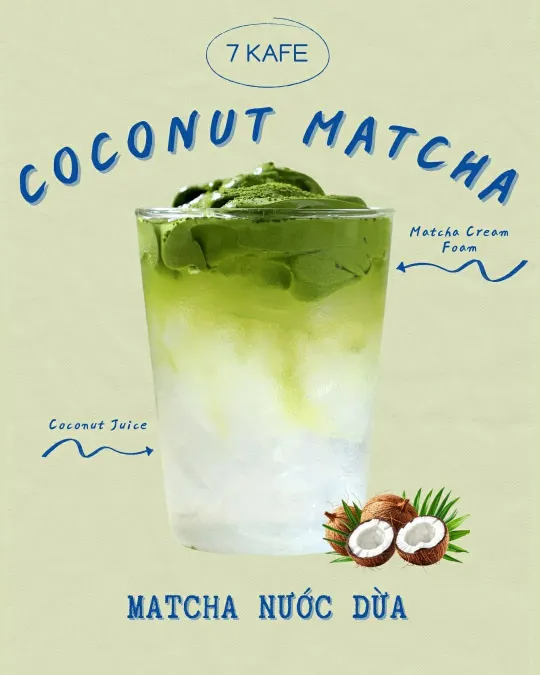
What is coconut matcha?
Coconut matcha is Japanese matcha powder blended with coconut milk instead of dairy. It’s a substitution that doesn’t just swap one liquid for another, but creates an entirely different flavor experience. Matcha’s umami depth and vegetal brightness meet the natural richness and gentle tropical warmth of coconut. The two work together in ways neither ingredient achieves alone. At 7 Kafe, this is a signature creation, built into the menu with intention, not added because it was trending.
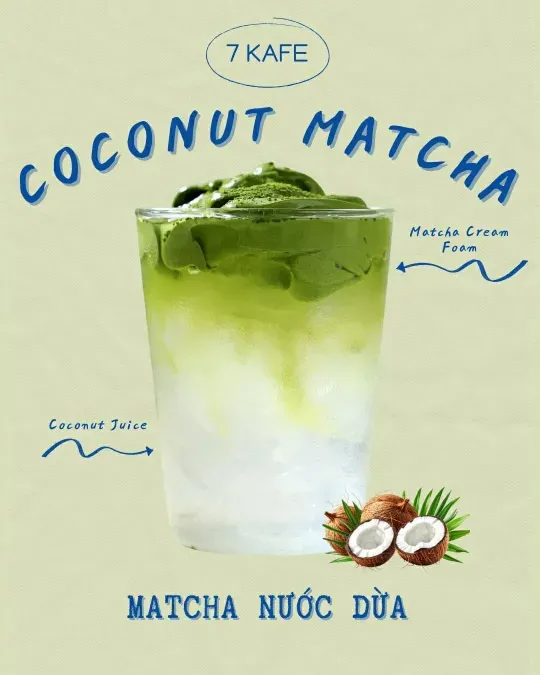
Why do matcha and coconut work so well together?
It sounds unexpected. Japanese matcha and tropical coconut, separated by thousands of kilometers of ocean. But the pairing is more logical than it appears:
Fat softens bitterness without masking flavor. Matcha carries a gentle bitterness alongside its umami character. The natural fat in coconut milk rounds that bitterness without silencing the tea, and actually helps the aromatic compounds in matcha come forward more clearly.
Natural sweetness, no sugar required. Coconut milk brings its own understated sweetness. Combined with matcha’s umami, most people find the drink doesn’t need added sugar. The balance is already there.
Layered aroma, complex in the best way. Matcha smells of fresh cut grass and subtle marine notes. Coconut adds a warm, tropical softness. These two aromatic profiles don’t compete; they create something more interesting than either one alone, shifting slightly with each sip.
Visually striking before you even taste it. Vivid jade green over creamy white creates a natural gradient that makes the drink genuinely beautiful. Before you stir it, this is already something worth pausing over.
Coconut matcha at 7 Kafe: what makes it different?
Coconut matcha isn’t a concept no one has tried. But how 7 Kafe approaches it creates a clear difference.
Many places use commercial canned coconut milk, overly sweet, artificial in texture, and loud enough to drown out the matcha entirely. At 7 Kafe, the ratio between matcha and coconut is calibrated so both voices are heard. Matcha is still the lead: vivid, aromatic, present. Coconut is the foundation, not the headline.
Served in a quiet zen space where the philosophy is slowness, where you’re not meant to rush a drink, coconut matcha becomes more than a menu item. It becomes a reason to sit still for twenty minutes in the middle of Saigon.
What does coconut matcha taste like?
This is the hard part to put into words, but here’s an attempt:
First sip: clean, green, with a soft whisper of coconut at the finish. Matcha leads. Second sip: coconut integrates more fully, its richness wrapping around the tea’s gentle bitterness and leaving something smooth and warm. By the third sip, you’ve stopped trying to identify which is which. There’s just one unified flavor, complex in a way that feels effortless.
It tastes nothing like a standard matcha latte. Nothing like coconut water. It occupies its own space, somewhere between the two, but entirely itself.
Iced or hot? Both are available at 7 Kafe. Iced keeps the matcha vivid and bright, with coconut adding a cool tropical undertone. Hot draws out the deeper, rounder notes in both: the kind of warmth that makes sense on a Saigon morning before the city fully wakes up.
Coconut matcha and your health: what’s worth knowing
Choosing coconut matcha over a standard matcha latte isn’t just a flavor decision. It shifts the nutritional profile in interesting ways:
Naturally dairy-free. Coconut milk replaces dairy entirely, making this a genuinely delicious option for people avoiding lactose or following a plant-based approach. Not a compromise, an upgrade.
Healthy fats from coconut. Coconut milk contains medium-chain triglycerides (MCTs), a type of saturated fat that the body metabolizes differently from long-chain fats. They are converted to energy more quickly, with less tendency to be stored.
Matcha’s clean caffeine. Around 25–35mg of caffeine per cup, paired with L-theanine, delivers focused alertness without the spike-and-crash cycle of coffee. The energy from coconut matcha is consistently described as steady: not loud, but reliable.
Antioxidant density from whole-leaf matcha. EGCG, the primary antioxidant in matcha, is present in concentrations higher than any other tea. Because you consume the entire powdered leaf rather than just the water it steeps in, every cup delivers far more than a comparable cup of brewed green tea.

Who will love coconut matcha immediately?
Coconut matcha isn’t for everyone, and that’s exactly what makes it interesting. But if you recognize yourself in any of these, you’ll probably be sold on the first sip:
Matcha-curious but bitterness-shy. Coconut milk softens matcha’s bitter edge naturally, making this one of the most approachable entry points to the tea. The flavor is fully present, just gentler.
A matcha regular who wants something new. Coconut matcha isn’t a replacement for a classic matcha latte; it’s an expansion. The tea character is intact, with a new dimension that makes it worth ordering again.
Avoiding dairy. This is a legitimate first-choice drink, not a fallback. The coconut milk isn’t here because there’s no other option. It’s here because it works.
Looking for something genuinely different in Saigon. The coconut matcha saigon scene is thin. Most cafes offer matcha latte and call it a menu. The version at 7 Kafe is a considered, distinct creation: harder to find than the standard options, worth seeking out.
People Also Ask
Can you drink coconut matcha every day?
Yes. With moderate caffeine from the matcha and healthy fats from the coconut, coconut matcha is a reasonable daily drink, particularly for those reducing coffee or avoiding dairy. Caffeine-sensitive individuals should keep it to morning or early afternoon.
Is coconut matcha sweet? Does it need sugar?
At 7 Kafe, the drink is calibrated to let the natural sweetness of coconut do the work, usually enough that additional sugar isn’t needed. Taste it first. If you want more sweetness, ask. If you want the cleaner version, it’s already there.
How is coconut matcha different from a coconut latte?
A coconut latte is built on espresso: bold, roasted, coffee-forward, with coconut as the milk. Coconut matcha replaces the coffee with matcha, which is lighter, greener, with an umami depth that espresso doesn’t have. Two completely different flavor profiles. Two different moods. Both worth trying if you’re at 7 Kafe.
Is coconut matcha available hot and iced?
Yes, both. Iced is the more popular order in Saigon’s heat. Matcha stays bright and the coconut reads as refreshingly tropical. Hot brings out warmer, rounder notes from both ingredients and suits the quieter pace of a morning visit.
7 Kafe is at 180/79 Nguyen Huu Canh, Binh Thanh, Ho Chi Minh City. Open every day, 7:00–22:00. Coconut matcha is on the menu, hot or iced, whenever you arrive.